Matt Carlson
This past September, I was part of a delegation to the Shinnecock Nation on what is now known as Long Island, New York. This was a delegation of seven individuals from across the United States organized by the Coalition to Dismantle the Doctrine of Discovery (https://dismantlediscovery.org/). I have been involved with the Coalition for the past number of years in a variety of roles and I welcomed the opportunity to begin building relationships with an Indigenous group on the East Coast.
“You’re the holdouts.”
The delegation spent two days with our hosts from the Shinnecock Nation, and we began each morning around a communal fire, sharing stories and hearing about the history and current initiatives of the Nation. One of our hosts, the Reverend Holly Haile Thompson, who is also the first Indigenous woman to be ordained in the Presbyterian Church USA, shared a story of an elder, Oren Lyons, who is a Haudenosaunee Faithkeeper of the Turtle Clan of the Onondoga and Seneca Nations. Now in his mid-nineties, an elder of elders, Lyons had come to the annual Powwow on the Shinnecock reservation. During his visit, he shared with Holly and others, saying, “You’re the holdouts,” meaning that the Shinnecock people were one of few indigenous groups on the East Coast of Turtle Island who resisted being pushed out by the early colonists, maintaining a continuous presence on their ancestral lands.
Stolen Land
In 1640, as European immigrants were beginning to establish themselves on Long Island, they were given land by the Shinnecock Nation that measured roughly 8 square miles (where the current Town of Southampton lies). But since that time, as Europeans continued to settle on Shinnecock land, there have been land disputes, with the colonists challenging whether the land was theirs. As a solution, the settlers approached the Nation and offered them a Thousand-Year lease on an area of land north and east of Shinnecock Bay, comprising 3,000 acres, just a fraction of the Nation’s original territory. The Shinnecock people accepted this solution, and they were able to then sublease the land to farmers and other settlers while maintaining access to their sacred sites. However, in 1859, the Long Island Rail Road made plans to extend existing rail service from New York City out to Montauk on the eastern end of the island, essentially bisecting the northern portion of the Nation’s land. According to the Non-Intercourse Act of 1790, any purchase or transfer of Native American land was prohibited unless it was done through a treaty or convention with the federal government. To circumvent this law, private investors presented a petition with 20 signatures to the New York State Legislature that supposedly gave the land to New York State. However, ten of the signatures on the petition were taken from the headstones of Shinnecock members who had passed away and the other ten were not even Shinnecock. The legislature accepted the petition, and the land became the property of the state. When the Shinnecock people learned of this fraudulent land acquisition, they immediately fought back, but because they weren’t considered US citizens, they were not allowed to pursue their case in court. The Shinnecock people were then forced into the eastern portion of their land, known as the Neck, a low-lying peninsula comprising 800 acres that is vulnerable to sea-level rise and storm flooding. This is where the current Shinnecock reservation lies.
Shinnecock Kelp Farmers
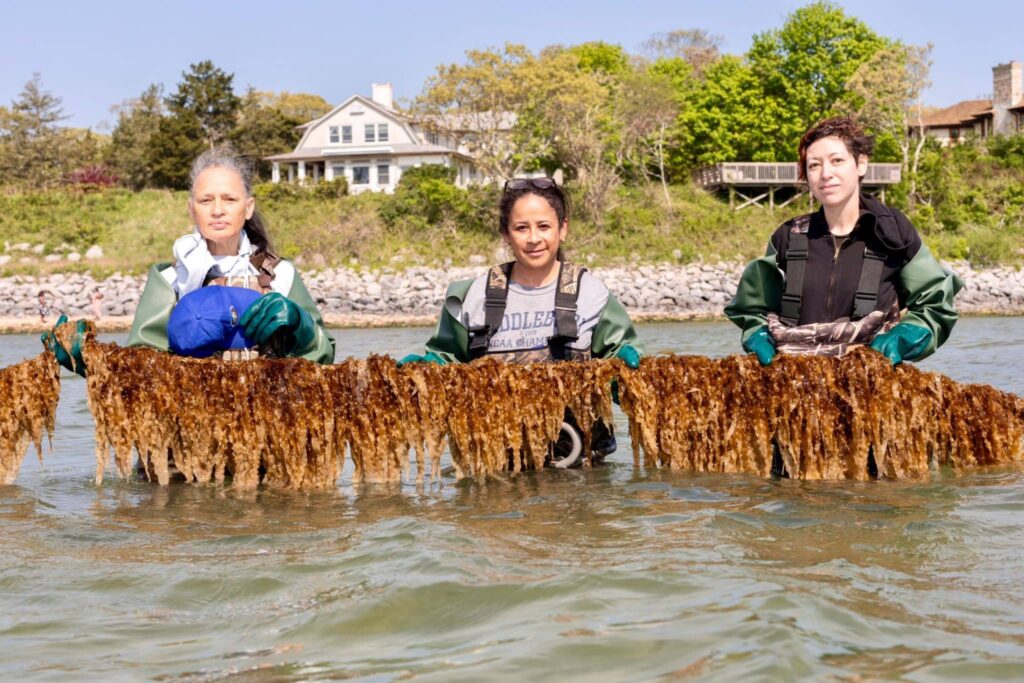
The ancient sacred sites, including burial sites, of the Shinnecock people are now covered by some of the most prestigious golf courses in the world. And even though one of these courses bears their name—Shinnecock Hills—the Shinnecock people are denied access. The Shinnecock reservation is surrounded by what is collectively known as the Hamptons, one of the wealthiest areas in the US, with Shinnecock Hills to the north and west, Southampton to the east, and Billionaire’s Row on a finger of land to the south and west. The Hamptons have become a destination for the rich and famous, which has led to rapid development and ridiculously high land prices. The infrastructure, however, has not kept pace, and there is a lack of adequate facilities to treat wastewater. As a result, the untreated wastewater from outdated septic systems and cesspools has been leaking into the groundwater and flowing into the Shinnecock Bay. This is harming the bay, with excess nitrogen causing toxic algae blooms, which deplete oxygen and destroy the marine life that is an integral part of the Shinnecock culture and economy. In response to this crisis, a group of women leaders from the Shinnecock Nation have resurrected the ancient practice of raising sugar kelp in the waters of the Shinnecock Bay (https://www.shinnecockkelpfarmers.com/). Kelp has the ability to sequester carbon and nitrogen, which will help heal the waters of the bay, and the harvested kelp can be sold as a natural fertilizer, which supports the Nation’s economy.
Opposition
Raising kelp is one piece of a larger effort to maintain ancestral ties to the lands and waters that the Shinnecock Nation has stewarded for thousands of years. Unfortunately, the continued development in the Hamptons and the unwillingness of local and state leadership to recognize the land rights of the Shinnecock Nation makes that effort extremely difficult. The purpose of the delegation was to learn how those of us who are newcomers to this land can help support the various initiatives of the Shinnecock Nation. With guidance from Shinnecock leaders, and as part of a larger network of allies, we are working to build a campaign to aid the Shinnecock people in realizing their economic and cultural sovereignty.
If you are interested in learning more about the Coalition to Dismantle the Doctrine of Discovery and/or the work of the Shinnecock campaign, feel free to reach out to me at mcarlson@akronmench.org.
Photo: Kelp farmers Donna Collins-Smith, Danielle Hopson Begun and Waban Tarrant. Credit: Cameron Peter & Nexus News Media